Shield
 Probe
 Strike
 LivStatus
 Grow
 Flow
 Pulse
 Kite
 Blink
Optimizely Supply Chain Attack: 178 Brands Hit. Is Your Site Next?
Published by Ketan Ramshawala, CTO
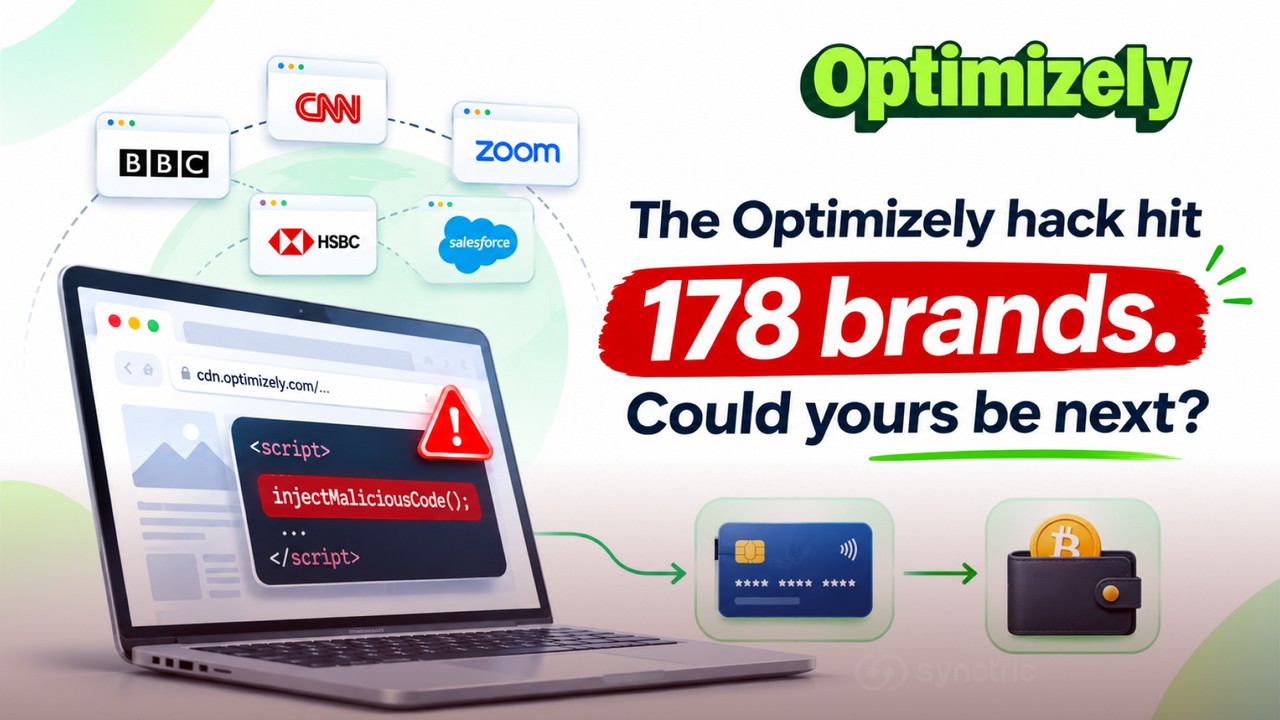
On 16 November 2026, visitors to websites run by the BBC, CNN, Zoom, HSBC, Salesforce and 170-plus other organisations loaded malicious JavaScript, though none of their own servers had been breached. The script came through Optimizely Web Experimentation, an A/B testing tool the sites already trusted and for up to 19 hours it swapped crypto wallet addresses, skimmed card details and went after older iPhones.
This Optimizely supply chain attack shows that a website is only as safe as the scripts it borrows. If yours runs an outside vendor's tag or widget, the same thing can happen to you.
What happened in the Optimizely supply chain attack (OPTIMJACK)?
An attacker found a flaw in Optimizely's Experimentation product and used it to write code into the "Project JavaScript" field of customer projects, which runs on every page view. The file still came from cdn.optimizely.com under Optimizely's own certificate, so browsers and most security policies let it through.
Security researcher Scott Helme and his team at Report URI found the injected code on 16 November. Researchers have since named the campaign OPTIMJACK.
Optimizely's status page notice, still marked "Monitoring" on 18 November, says the company fixed the vulnerability, removed the code, secured affected accounts and added protections against unauthorised code delivery. In press statements it added that the flaw sat in the account signup flow, that tokens were revoked and that affected customers were told. It hasn't said how a signup flaw reached other customers' projects.
Time (UTC) | Time (IST) | What happened |
16 Nov, 04:21 | 16 Nov, 09:51 | First injected code seen, on the BBC's snippet |
16 Nov, 13:43 | 16 Nov, 19:13 | Card skimmer added |
16 Nov, 17:13 | 16 Nov, 22:43 | iPhone exploit code added for iOS 18.6 and earlier |
16 Nov, 23:11 | 17 Nov, 04:41 | Last infected file cleaned |
17 Nov, 01:02 | 17 Nov, 06:32 | Optimizely posts its status-page notice |
Timeline of the Optimizely Web Experimentation compromise. Sources: Report URI, Black Kite and Optimizely's status page.
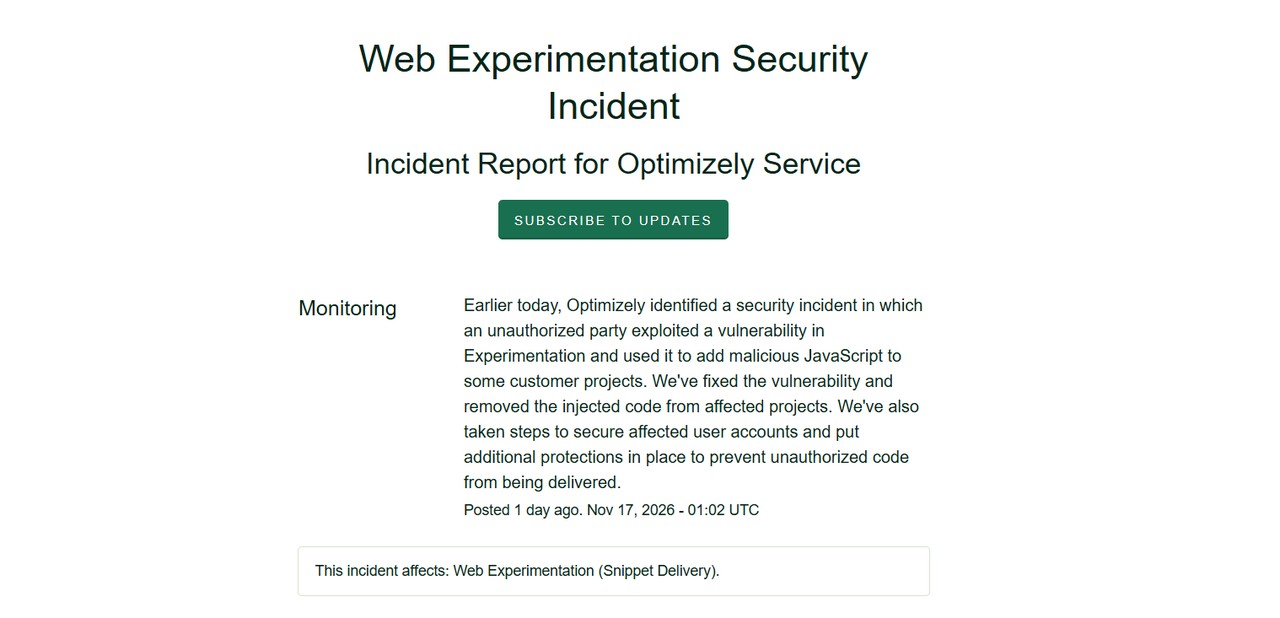
Image Source : status.optimizely.com/incidents/ftw0fh9wx43z (posted 17 Nov, 01:02 UTC)
Which websites were affected by the Optimizely hack?
Report URI found 188 infected snippets out of 1,611 checked, belonging to 178 organisations, including the BBC, CNN, Fox News, Zoom, Salesforce, GitLab, IKEA, HSBC, Equifax, Air France-KLM, Peacock and TalkTalk. The Register reported that Optimizely's own website and login portal carried the code too. The real number is probably higher, since not every snippet was checked.
Technology and SaaS (23 organisations) and retail (20) were among the hardest-hit sectors, behind only banking and finance. Being listed doesn't mean every visitor was harmed.
What did the Optimizely malware steal?
The code went after visitors, not the websites and changed through the day. It could:
- Swap crypto wallet addresses in page text, forms and the clipboard, sending payments to the attacker.
- Skim card numbers, expiry dates and CVVs from a site's own checkout forms. Cards typed into a payment provider's hosted frame were out of its reach.
- Steal cookies without the HttpOnly flag, along with page screenshots, which can expose signed-in sessions.
- Push the Coruna and DarkSword exploit kits to older iPhones and iPads.
Report URI traced about $7,040 in cryptocurrency to the attacker's wallets. That figure covers crypto only. Nobody yet knows how many cards were skimmed or how many iPhones were compromised.
Is your website at risk from a third-party script attack?
Yes, if your site loads JavaScript from an outside service. BuiltWith counts about 190,000 live sites using Optimizely, but a chat widget, analytics tag or ad script carries the same kind of risk. Report URI saw related injections through Kissmetrics, StorifyMe and Minute Media scripts in the days before the Optimizely wave.
Try this: open your checkout page, open developer tools and filter the Network tab to JS. Every outside domain listed can change what customers see and type. If you can't say who owns each one, start there.
How to prevent a client-side supply chain attack
A client-side supply chain attack, where a supplier's script turns hostile in your visitors' browsers, can't be fully blocked from your side. You can limit where outside scripts run and spot changes fast.
Why CSP and SRI only partly worked
Report URI checked affected sites' Content Security Policy (CSP), the browser rule listing which scripts and connections a page may use. 68 sites had none and only 24 blocked the payload outright. Another 17 let the code run but stopped the stolen data leaving.
Allow-listing Optimizely did nothing, since the code came from its own domain and 'unsafe-eval' or 'strict-dynamic' let it through on some sites. Subresource Integrity (SRI), which pins a script to a fixed fingerprint, didn't fit either: the snippet changes with every published experiment.
What held up best was distance. Palo Alto Networks' Unit 42 advises keeping marketing, experimentation and analytics tags off login and checkout pages and placing payment collection inside hardened, cross-origin iframes. PCI DSS 4.0.1, the card industry's security standard, already asks for this: Requirement 6.4.3 wants an approved inventory of payment-page scripts and 11.6.1 wants alerts when those pages change.
Prevention steps to take this week
- Optimizely Web users: check every project's Project JavaScript field and change history around 16 November. Search for 1688360, atob( and eval, since some loaders hid the address.
- Review Optimizely users and API tokens. Remove what you don't recognise, rotate the rest and turn on multi-factor authentication.
- Search DNS, proxy and CSP logs from 13 November onwards for 1688360.cc and webshell.lol.
- Take non-essential tags off checkout and login pages and move card entry into your payment provider's hosted frame.
- Set a strict CSP for script-src and connect-src. Start in report-only mode and leave out 'unsafe-eval'.
- Keep a third-party script inventory, with alerts for unexpected changes.
Patch and update notes (as of 18 November 2026)
Optimizely's status page lists the incident under Web Experimentation (Snippet Delivery), still in Monitoring. The flaw is fixed and the code removed. No CVE has been assigned and no root cause published. Site owners have nothing to install, only projects and logs to audit. The exploit kit's own comments indicate iOS 18.7.3+ and 26.3+ are out of reach, so update older iPhones and iPads. On iOS 18.6 or earlier, affected pages reloaded every 60 seconds
How to respond to a third-party script compromise
Treat it as a breach of your website, even with your servers untouched. A response team would usually:
- Find which pages loaded the snippet and when. Historical logs matter more than today's scan, because the code was gone by 23:11 UTC on 16 November.
- Preserve CDN, proxy and CSP logs and the vendor project's change history.
- Disable the vendor script, revoke sessions tied to readable cookies and rotate vendor credentials.
- Hunt for disguised versions of the published indicators and work out whose data left.
- Notify payment processors, your national cyber agency (CERT-In, in India) and affected customers.
- Tighten CSP, cut tags on sensitive pages, add change monitoring and retest.
- Get the vendor's written confirmation of impact, then decide whether its script stays.
Why banks, fintechs and online stores should act first
Banking and finance was the largest group on Report URI's list, with 32 organisations. Lenders, payment firms and online stores put marketing tags and chat widgets on the same pages as card and login fields and each tag can write to your customer's browser. Most affected companies didn't catch it; an outside researcher did. So ask this week: who could change the code on our checkout page right now and would we know?
Why penetration testing and threat intelligence matter for third-party risk
Third-party scripts fall between teams. Marketing adds the tag, engineering owns the site and security reviews in-house code, so nobody owns the vendor's script once it's live. A cyber security and threat intelligence partner fills that gap.
Threat intelligence tells you when a supplier is under attack; Report URI's findings were public before Optimizely's notice. Penetration testing, a controlled attack on your own systems, shows how far an attacker gets once something lands, such as whether stolen cookies open an admin panel. Neither replaces a vendor fixing its platform.
How Probe tests your own web applications
Synctric built Probe to run that kind of testing on a schedule, not once a year. It checks your websites, APIs, cloud systems and mobile apps for the ways an attacker could get in, then tests whether each weakness can actually be exploited or linked with others into a bigger break-in. That includes your login, checkout and session handling, the pages a compromised vendor script goes after first.
Want to know more about Probe? Take a closer look at how it works.
What the Optimizely supply chain attack teaches website owners
The Optimizely supply chain attack needed no breached server at any of the 178 organisations, just one weak signup flow at a vendor they trusted. The sites that fared best had already decided which scripts belonged on checkout and login pages. Pull up your checkout page's script list today and remove anything nobody can explain.
Optimizely hack FAQs
What is OPTIMJACK?
OPTIMJACK is researchers' name for the November 2026 campaign that planted malicious JavaScript in Optimizely Web Experimentation customer projects. Served from Optimizely's own network, it ran like any other script.
Is this the same as the February 2026 Optimizely data breach?
No. In February 2026, Optimizely confirmed a voice phishing attack had exposed basic business contact details from internal systems. The November attack is separate: a product flaw used to plant code that reached website visitors.
I visited an affected site on 16 November. What should I do?
Update your iPhone or iPad. If you entered card details, check statements and switch on alerts. Confirm any crypto address copied that day through another channel and watch for unfamiliar sign-ins. Malwarebytes has a fuller checklist for visitors.
Is it safe to keep using Optimizely?
Optimizely says the flaw is fixed, so it's a business call. Check who can edit your projects, ask Optimizely to confirm in writing whether you were affected and keep it off checkout and login pages. Optimizely MVP Mark Stott has written up practical CSP lessons for Optimizely customers.
Has this kind of attack happened before?
Yes. Starting in 2017, Ticketmaster's site was compromised through scripts from two outside suppliers, SociaPlus and Inbenta. In 2024, polyfill.io changed hands and its script turned malicious on 100,000-plus sites. In September 2026, Sansec estimated a Brevo compromise reached more than 100,000 sites.
Is my site safe if I serve the Optimizely snippet from my own domain?
No. Customers who served the snippet from their own domain were affected too, according to Black Kite, because the content still came from the same Optimizely project. If you proxy or self-host it, purge your caches and replace any locally cached copies.